Half-Handmade Yixing Teapots: What the Mold Does—and What the Hands Still Do
A visit to a real Yixing workbench, where clay slowly becomes something you can hold, pour from, and live with.
Introduction: The Most Misunderstood Word in Yixing Teaware
If you run a Chinese tea shop in Amsterdam, Madrid, or Melbourne, you may know this scene.
A customer picks up a little Yixing teapot, turns the lid gently, looks underneath, and asks:
“Is this fully handmade?”
When you explain that it is half-handmade, a little hesitation may follow.
“Half-handmade? Does that mean a machine made the other half?”
We understand the question.
For buyers who have never seen a Dingshu workshop, the word mold can bring to mind assembly lines, machine-pressed products, and endless identical copies.
But traditional Yixing half-handmade work is far more interesting than a simple division between human hands and machines.
If you ever visit Dingshu, pull up a stool beside a potter's wooden workbench.
You will hear the steady tapping of a wooden mallet against clay. You will watch a flat strip of zisha gradually become the body of a teapot.
A plaster shaping mold may enter the process at a particular moment. But it does not automatically produce a finished vessel.
And after the mold is removed, there is still a great deal of careful handwork ahead.
Rather than asking you to believe the words traditional craftsmanship, we would much rather show you the work itself.
I. Before the Mold Appears, the Clay Is Already Taking Shape by Hand
In traditional half-handmade work at our studio, the story does not begin with a machine or a plaster mold.
It begins with prepared zisha clay, a wooden workbench, and the tools a maker knows by touch.
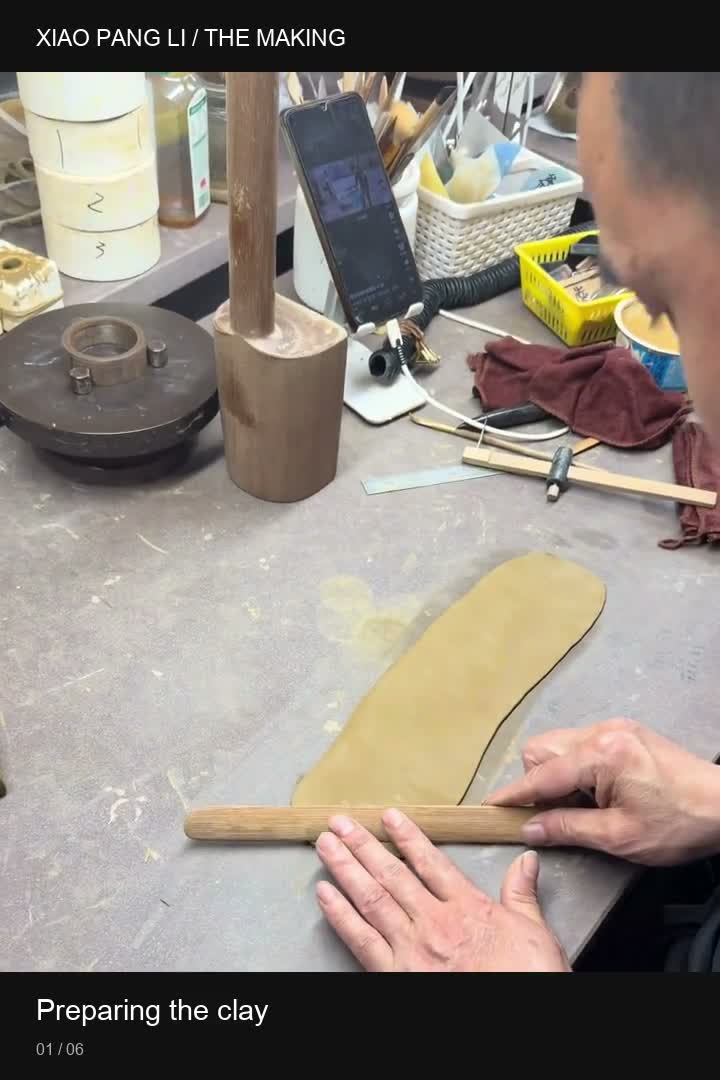
The Sound of the Wooden Mallet
The maker takes a block of clay and works it repeatedly with a wooden mallet.
Tap. Tap. Tap.
Under a steady rhythm, the clay gradually spreads into a relatively even slab.
It looks simple. But it takes experience.
If the slab is too thick, shaping and finishing become more difficult. If its thickness is poorly controlled, the body may become less even.
The maker observes the clay as it responds, adjusting pressure and movement along the way.
A Flat Strip Becomes the Body of a Teapot
The clay is then trimmed to the dimensions required by the form and joined into a hollow body.
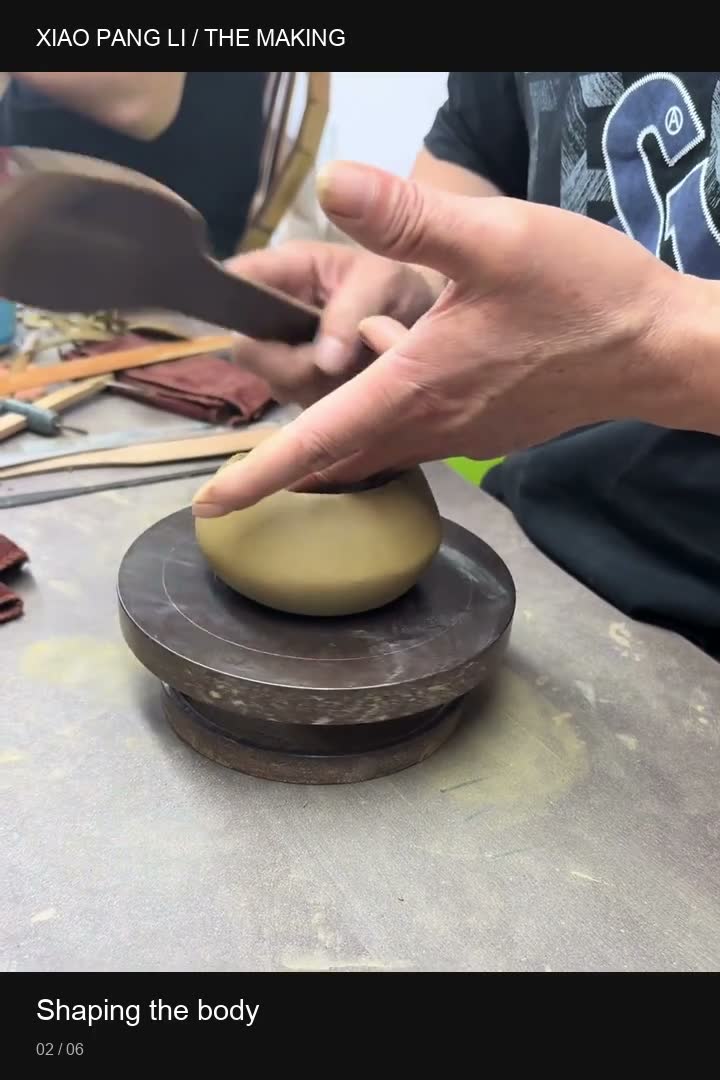
The maker works the seam and begins adjusting the profile with fingers, palms, and wooden tools.
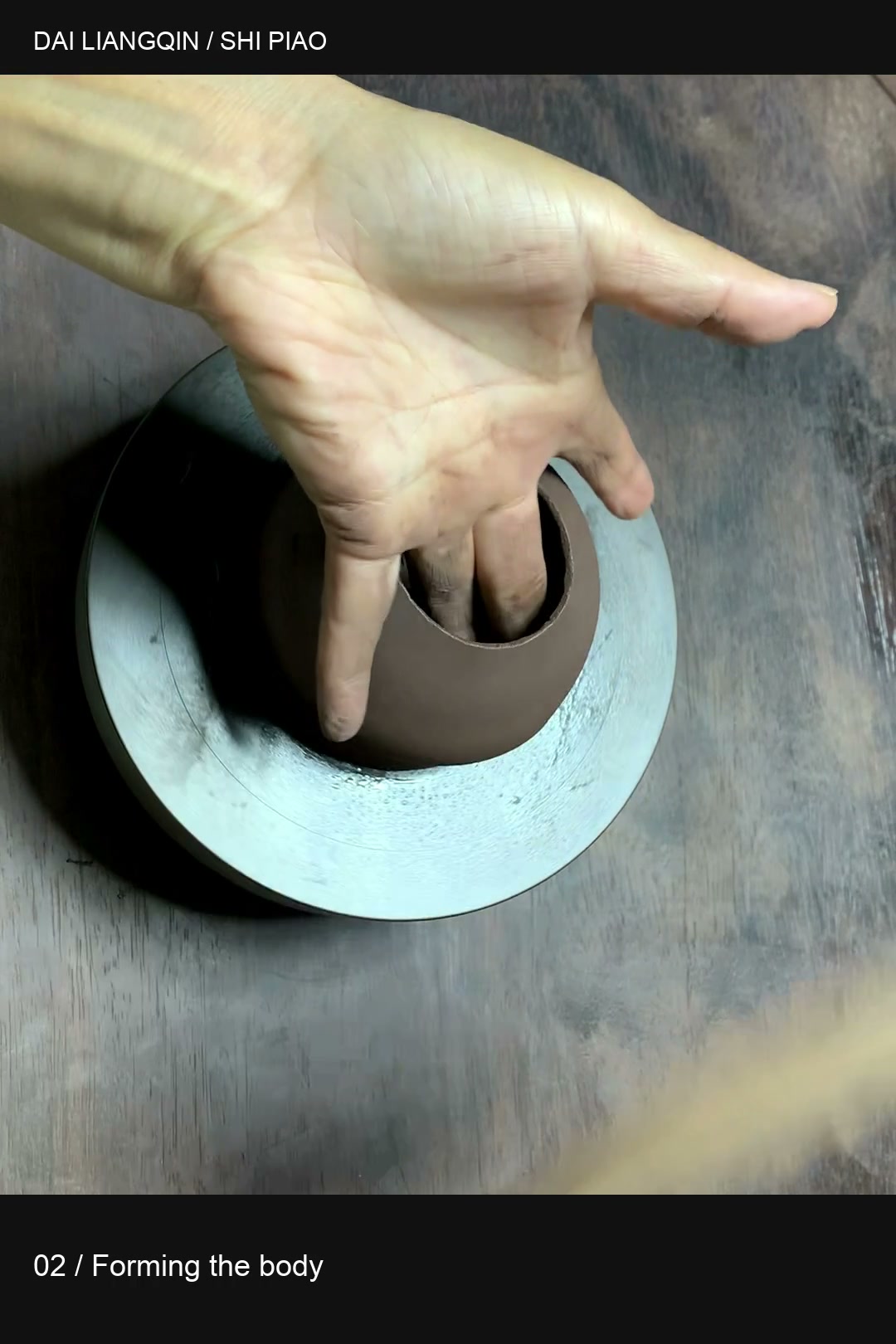
One hand supports the inner wall while the other works the outside.
As the body turns on the workbench, its outline slowly changes.
Some forms become full and rounded. Others sit low and grounded. A pear-shaped body gradually develops its characteristic upright silhouette.
This is one of the loveliest moments in making a Yixing teapot.
A flat piece of clay begins to acquire a personality of its own.
II. What Does the Plaster Mold Actually Do?
Once the clay body has been shaped by hand, a supporting mold may be introduced for the forms that require it.
The maker places the still-soft body into the shaping mold, then carefully adjusts the wall from the inside with fingers and appropriate tools.
In traditional Yixing making, this kind of operation is often called tang shen tong—working the clay body against its shaping support.
This is not a matter of pouring liquid slip into a mold. Nor is it pressing a button and watching a machine produce a teapot.
So What Is the Mold Good For?
It helps the maker maintain the recognisable outline of a familiar form.
Imagine a tea room that falls in love with a particular Xishi and wants to restock a similar shape later.
A mature mold-assisted process can help a workshop maintain greater consistency within a familiar design.
That matters to tea merchants who need a collection they can return to, rather than a single exceptional object that can never be sourced again.
But the mold does not make every decision.
It cannot finish the spout, handle, and lid by itself. It does not determine whether the finished pot feels comfortable in the hand or pours well.
Even when a similar shaping mold is used, different clays and firing conditions can produce variations in the finished dimensions.
The mold helps keep the form consistent. The maker still has to turn that form into a teapot that works.
There is no contradiction between the two.
III. The Quiet Work That Continues After the Mold Comes Off
A shaped clay body is still only a beginning.
It needs a spout, a handle, and a lid. Its joins and surfaces must be refined. Every part has to find its place within the whole.
Much of what makes a teapot pleasant to use lies in these details.
Spout and Handle: Making the Parts Belong Together
The maker prepares, shapes, refines, and attaches the spout and handle according to the requirements of the form.
Their position, angle, and lines all deserve attention.
On the finished teapot, the spout should not look like an afterthought. The handle should belong naturally to the body, both visually and in the hand.
Ideally, every part looks as though it was always meant to be there.
The Small Holes Inside Matter Too
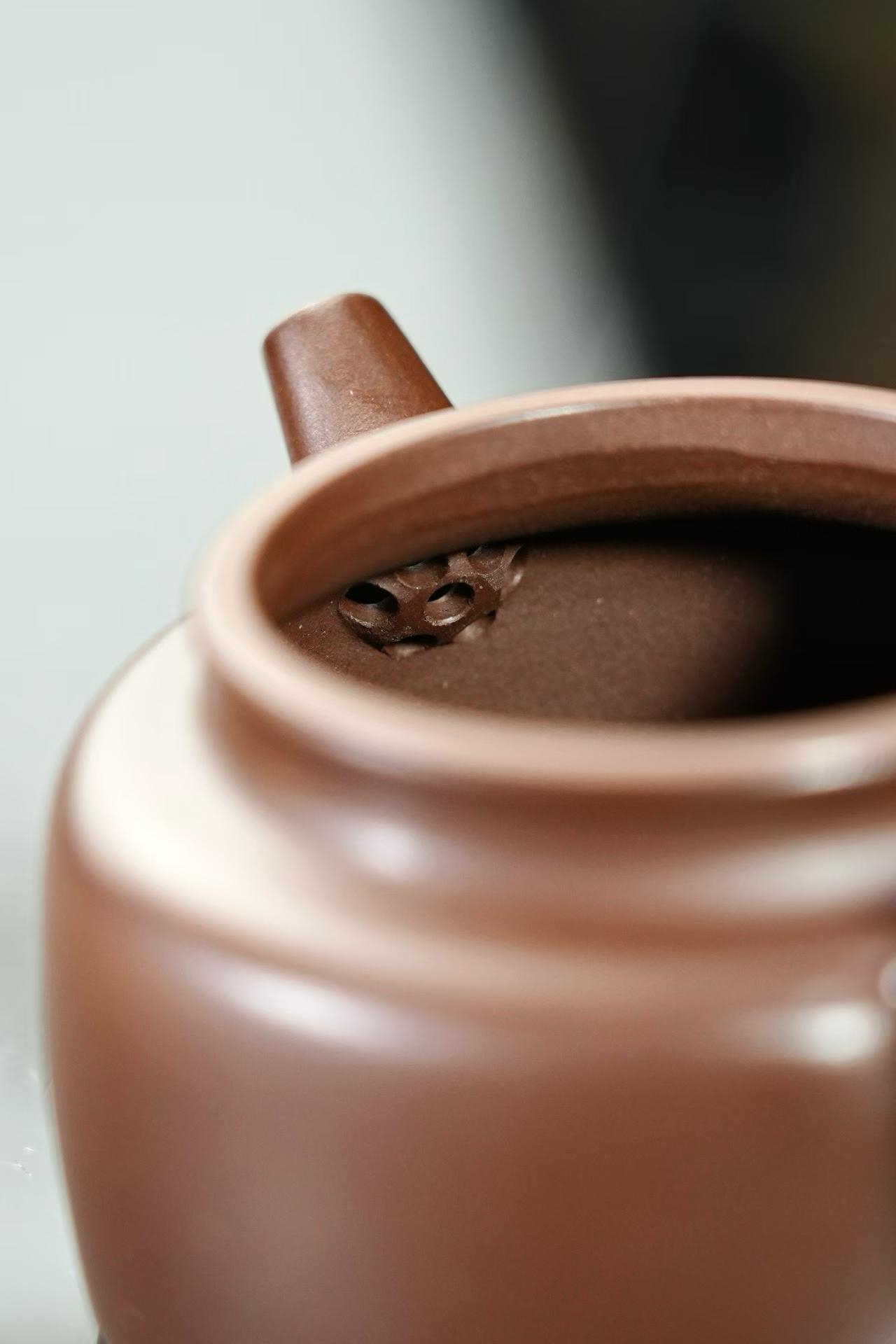
Have you ever looked carefully inside a Yixing teapot?
Where the spout meets the body, you will often find a group of filter holes.
They may seem like a tiny detail, but they play a practical role in daily brewing.
The filter's construction, the cleanliness of the openings, and their relationship to the spout all contribute to the way water leaves the pot.
Watching a maker work on this part of a teapot offers a particularly interesting glimpse of the craft.
Fitting the Lid: A Test of Patience
The lid and mouth may look like a simple pair.
But the maker must consider the shape of the opening, the fit of the lid, and the dimensional changes that can happen during drying and firing.
The pieces are checked and adjusted with care.
For someone who makes tea every day, the result becomes immediately practical.
Does the lid lift easily?
Does it return to its seat comfortably?
Does it feel stable while the pot is being poured?
These modest details can make an enormous difference to daily use.
Mingzhen: The Final Refinement of the Clay Surface
Later in the making process, the artisan continues refining the surface with traditional burnishing tools.
A thin horn tool follows the curves of the clay.
Over and over, it passes across the body, bringing the surfaces and joins into a more coherent finish.
The movements are rarely dramatic.
Sometimes all you see is a gentle turn of the wrist as the tool follows a curve.
Yet these quiet gestures help give the finished vessel its considered, carefully worked character.
The warmth of a finished Yixing surface does not need exaggerated lighting to explain it.
Sometimes the most beautiful image is simply a pair of hands at work in natural light.
IV. Why Professional Tea Rooms Choose Half-Handmade Yixing Teapots
For an independent tea shop or a carefully run tea room, buying a teapot is about more than finding a beautiful object.
It is also about running a business.
Imagine several tea tables in service, with staff brewing Dancong, Wuyi Rock Tea, and Puerh in small pots throughout the day.
A customer enjoys one of your Shipiao teapots and asks to buy one.
A few weeks later, another customer wants something similar.
As the shop owner, what do you need?
A familiar form. Clear capacity information. A workshop you can return to. And above all, a teapot that feels right in daily use.
Traditional half-handmade methods, combined with a mature workshop collection, can help bring these needs together.
They retain meaningful work at the potter's bench while making familiar forms more practical to offer as an ongoing range.
Of course, the label half-handmade is not, by itself, a guarantee of quality.
What earns a buyer's confidence is clear product information, real records of the making process, and a finished teapot that performs well on the tea table.
Different Crafts Have Different Places at XUJIE
Standard Workshop Line
Our collection of eleven familiar everyday forms is designed for real tea service, retail displays, and independent tea businesses.
Mixed wholesale orders begin at five pieces, allowing shop owners to explore different sizes and shapes in their initial selection.
Atelier Reserve
Our second collection contains ten selected forms with a different focus on refinement and individual choice.
It is presented separately from the Standard Workshop Line. Details of each piece, including clay, making method, and sourcing arrangements, are confirmed through its current product information.
Li Feng's Fully Hand-Built Square Ware
Master Li Feng follows a distinct tradition of constructing square Yixing vessels from carefully prepared clay slabs without a body-forming mold.
The work demands a different approach to structure, angles, joins, and proportion.
Lin Lai's Hand Engraving
In another part of the studio's practice, Lin Lai combines drawing, calligraphy, and hand engraving on curved ceramic surfaces.
This is an artistic discipline of its own, not a standard finishing step applied to every unadorned wholesale teapot.
These different practices do not need to be reduced to a simple ranking.
A thoughtful buyer chooses according to the object itself, and to the needs of the people who will use it.
V. In the End, Let the Water Speak
One of the most revealing moments in a teapot's journey from workbench to tea table is the moment it actually meets water.
We love the simplicity of it.
A teapot sits quietly beside the testing sink.
Someone lifts it, pours in clean water, and places the lid on top.
Then the wrist tilts gently.
A stream leaves the spout and falls into the vessel below.
And however beautiful the teapot may look, the question becomes wonderfully simple:
How does it pour?
Is the stream continuous?
Does the pot feel natural when tilted?
Can the water be poured out comfortably?
How does the stream finish?
Does the lid remain stable?
These questions cannot be answered by the words fully handmade or half-handmade alone.
Some makers also cover the lid's air hole to observe how the flow changes. It can be one useful observation, but the pot's behaviour during normal pouring matters just as much.
We would rather let a buyer see that real stream of water than repeatedly promise that our teapots pour perfectly.
For someone running a tea shop, the experience of using the pot matters far more than another beautiful marketing phrase.
VI. From the Dingshu Workbench to Your Tea Shelf
If you are choosing your first Yixing pieces for a tea room, a few familiar forms are a lovely place to begin.
Perhaps a Shipiao.
Low, grounded, and quietly assured.
Or a Xiao Pang Li.
Upright at the neck, rounded through the belly, and full of character on a small tea tray.
Or perhaps a Dezhong.
Composed and architectural, with the unmistakable lines of a traditional form.
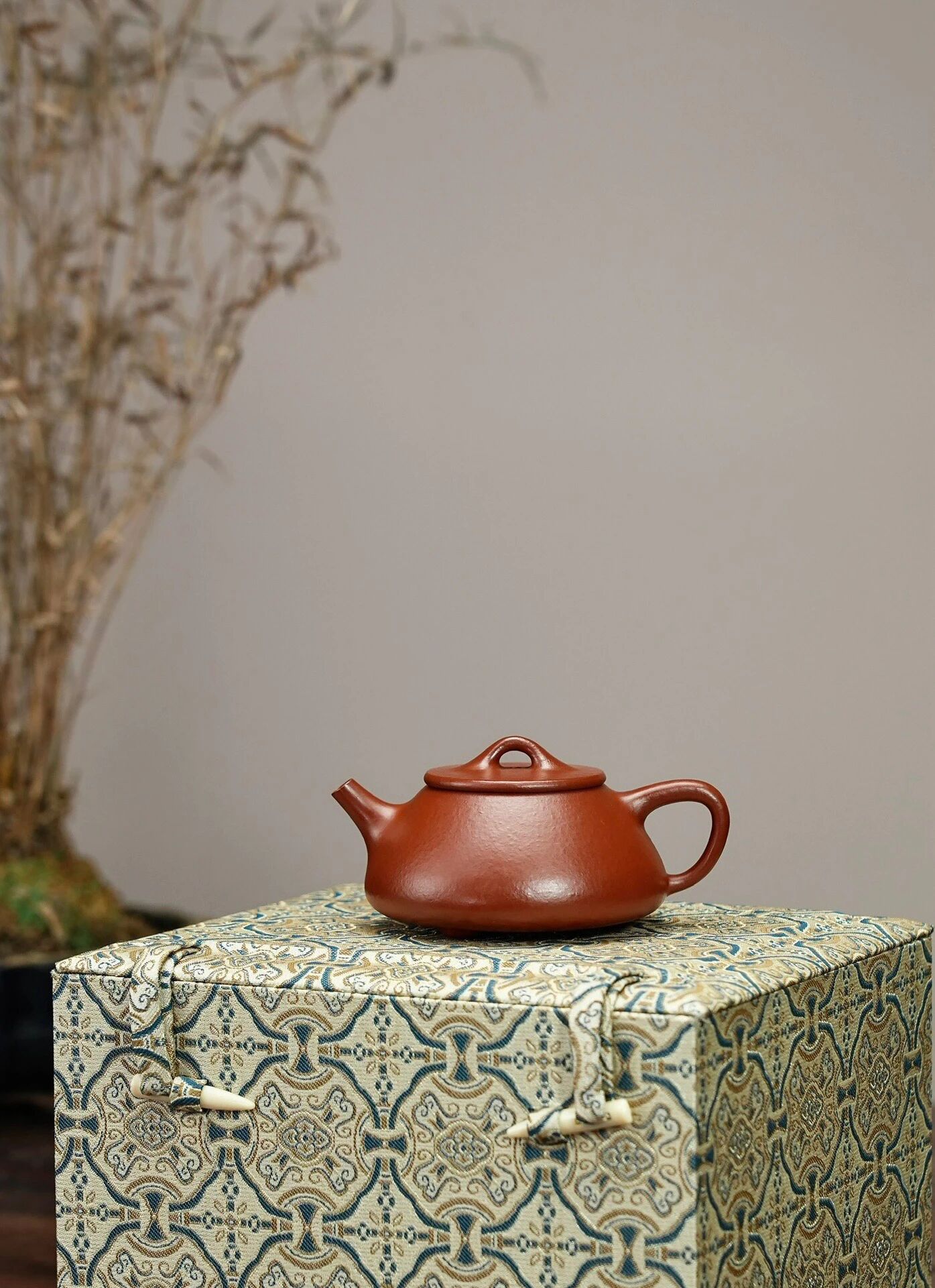
Classic Shipiao
Compare the current clay and capacity options.
See this teapot →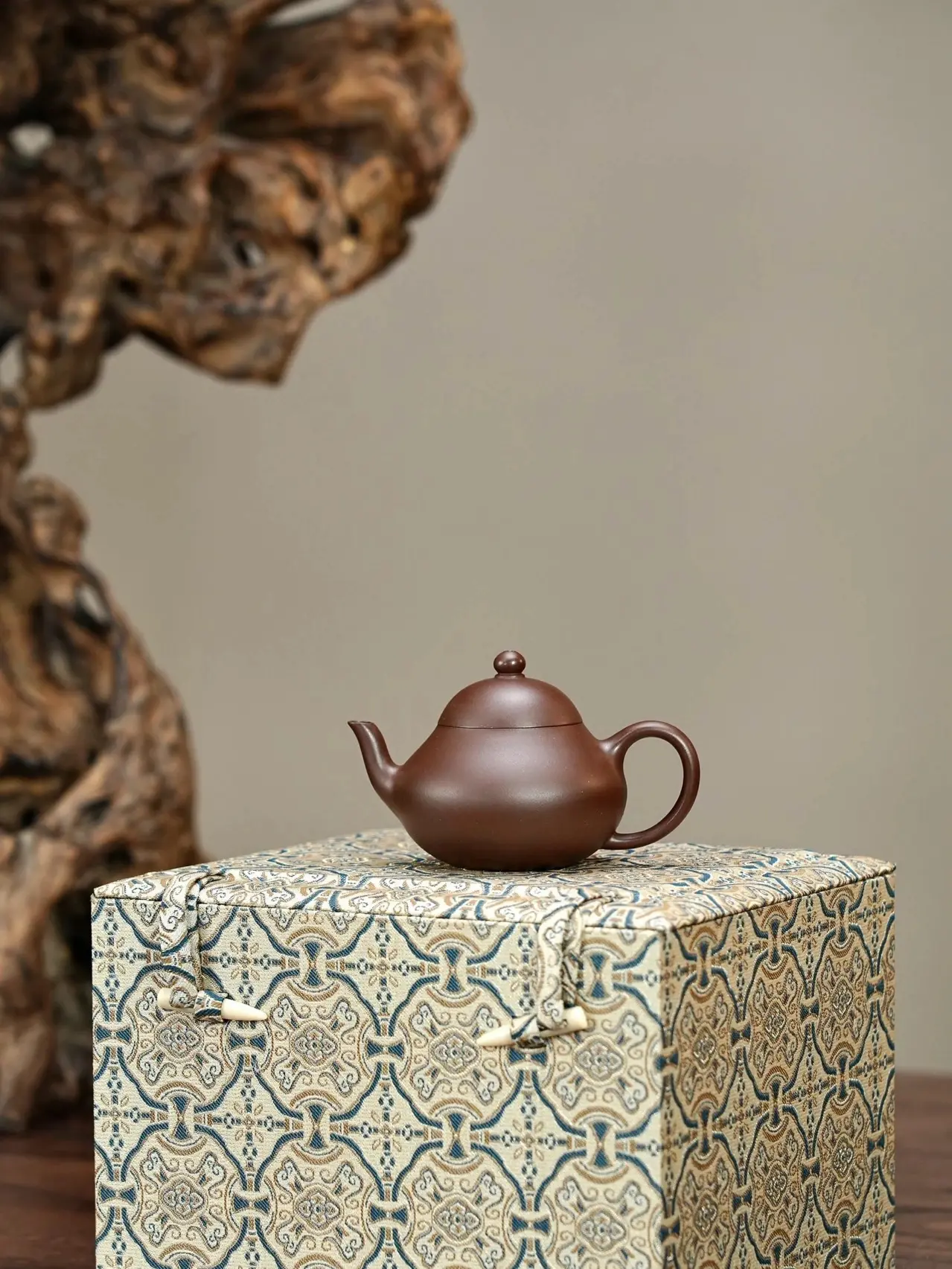
Xiao Pang Li
Explore the pear silhouette and clay versions.
See this teapot →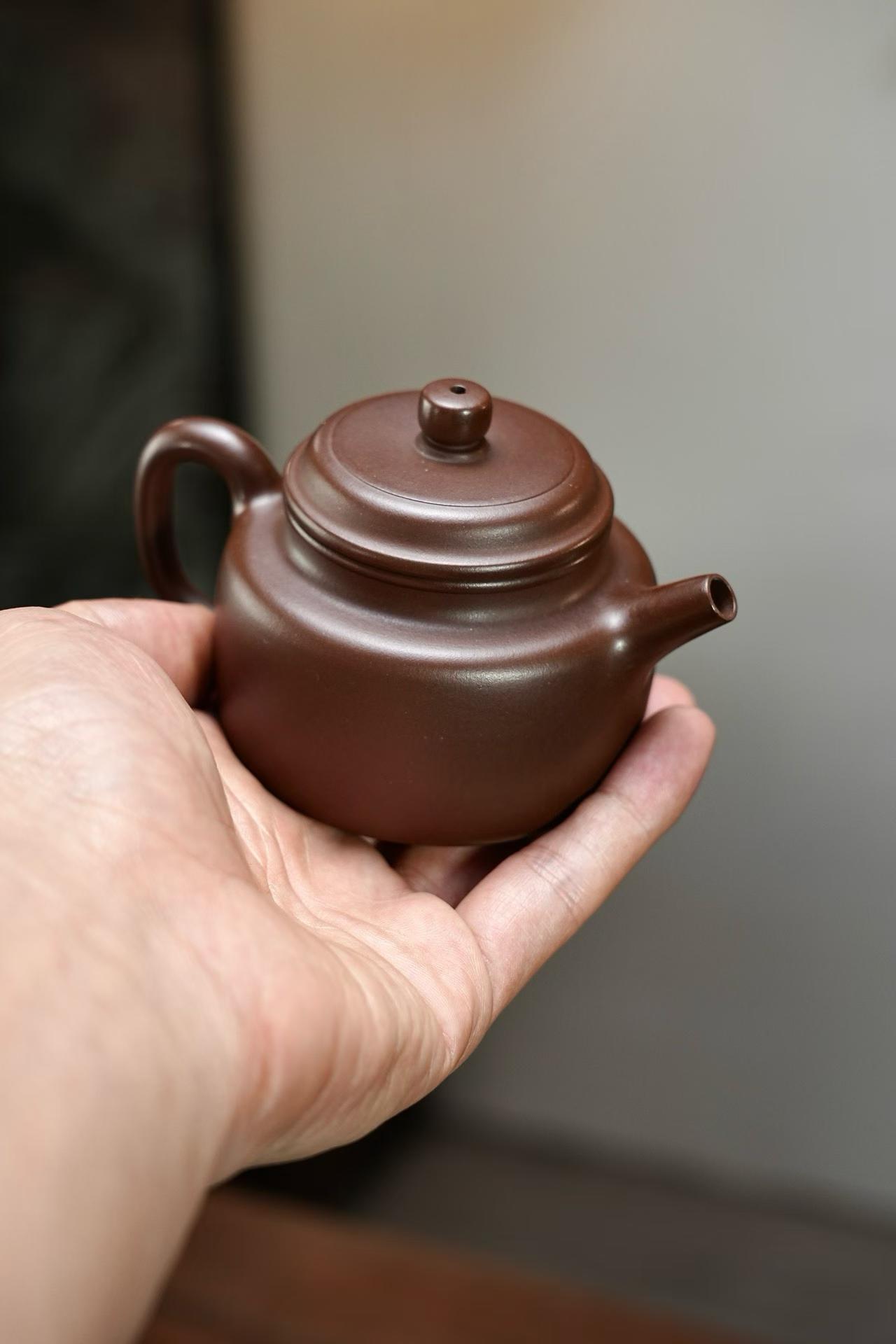
Classical Dezhong
See the upright form and its current details.
See this teapot →Every form offers a different relationship between shape, capacity, clay, and the hand.
There is no reason every customer must fall in love with the same teapot.
The pleasure is in helping someone discover the one they will want to reach for every morning.
You can explore the real photographs and specifications of our current collection on the XUJIE website, then add any pieces you like to your Request List.
For a tea room planning its first retail selection, the Standard Workshop Line supports mixed wholesale orders from five pieces. If you would prefer to experience a single piece first, you can also ask us about an evaluation sample.
Specific forms, clay options, availability, and quotations are confirmed privately.
And if you are not sure where to begin, tell us a little about your tea room.
What teas do your customers love?
How many people usually share a session?
Are the teapots mainly for brewing behind the counter, or for customers to take home?
We would be delighted to start with these everyday questions and help you explore the possibilities.
Conclusion: See the Hands. Then Choose the Pot.
If you ever find yourself in Dingshu, you may discover that a potter's workbench is not nearly as mysterious as you imagined.
There is the sound of a wooden mallet.
The soft friction of clay against a tool.
The quiet moment when a maker turns the body and bends closer to inspect a curve.
A mold may appear for one part of the work.
But a teapot worth using still depends on many small, thoughtful decisions made along the way.
We understand why buyers care about the difference between fully handmade and half-handmade.
Those words have meaning.
But the value of a teapot cannot be measured by a percentage of handwork alone.
What matters is whether you can understand how it was made, know what clay and form you are buying, and feel happy bringing it to your own tea table.
Perhaps the next time you turn a Yixing teapot in your hands, you will notice a little more: the curve of its lid, the quiet work inside the chamber, or the way water leaves the spout.
Different forms belong to different tea tables. Part of the pleasure is finding the one that feels right on yours.
The workshop photographs, making films and current teapot details are here whenever you feel like taking a closer look.
Warm regards from the workbench in Dingshu,
XUJIE Studio
Yixing, China
See the hands. Then choose the pot.
From the workbench to your tea table
See the making process, explore the forms you love, and save a few favourites to your Request List. When you are ready, we can talk through the details together.